Abstract
This study presents a methodological framework for incorporating the direction-dependent deformation characteristics of karakul fur into the design of outerwear components. The primary objective is to demonstrate how relative deformation indicators can be interpreted and translated into practical considerations for garment pattern development. The study is structured as a methodological demonstration based on illustrative values rather than an experimental investigation of physical specimens. A relative-deformation measure is introduced to describe dimensional changes in different material directions. A conceptual procedure is then proposed for comparing deformation indicators across material orientations and garment zones and for determining differentiated pattern allowances according to the expected deformation behavior of the material. The illustrative values serve exclusively to explain the calculation procedure and demonstrate the potential application of the proposed framework. They do not represent experimentally measured properties, validated deformation coefficients, or statistically established characteristics of karakul fur. The proposed methodology provides a structured approach for organizing deformation-related information and identifying potential adjustments to pattern dimensions during the preliminary design of outerwear. However, its practical reliability remains limited by the absence of an experimentally validated dataset and quantitative relationships between material deformation and garment dimensional stability. Future research should investigate karakul fur specimens with documented origins, grades, and processing conditions. Experimental procedures should follow applicable conditioning requirements and standardized testing methods to ensure the reproducibility and comparability of measurements. Particular attention should be given to evaluating deformation under different loading conditions, material directions, and environmental influences. Subsequently, the relationship between measured deformation indicators and dimensional changes in finished garment components should be statistically analyzed and experimentally validated. These investigations would establish an evidence-based foundation for developing reliable deformation coefficients and improving the accuracy of pattern corrections for karakul fur outerwear.
Keywords
Karakul Fur, Deformation Properties, Outerwear Design, Pattern Construction, Dimensional Stability, Garment Technology,
Fur Materials, Design Optimization
1. Introduction
This article focuses on improving methods for designing outerwear components by taking into account the deformational properties of karakul fur. The development of modern fur garments requires not only consideration of aesthetic characteristics but also a scientifically substantiated approach to the mechanical behavior of the material during cutting, sewing, forming, and subsequent operation. Karakul fur differs from conventional textile fabrics because its structure consists of a natural leather substrate and a hair covering with specific physical and mechanical characteristics. The heterogeneous structure of the material determines its response to external forces and directly affects the dimensional stability and geometric accuracy of garment components.
In the design of outerwear, the deformation of fur material can occur as a result of tensile forces, bending, compression, technological handling, and repeated mechanical loading during wear. If these characteristics are not considered during pattern development, dimensional deviations may appear in individual components. Such deviations can lead to changes in the silhouette, imbalance between adjoining parts, distortion of seams, and deterioration of the overall appearance of the garment. Therefore, the development of design methods based on experimentally established deformation characteristics represents an important scientific and technological problem.
Traditional methods of garment pattern construction generally rely on standardized anthropometric measurements, geometric relationships, and established construction allowances. Although these approaches are effective for many textile materials, their direct application to karakul fur may not provide sufficient dimensional accuracy. The natural variability of fur skins, differences in leather thickness, density, elasticity, and direction-dependent deformation require additional technological and design parameters. Consequently, a material-oriented design methodology is needed to establish a closer relationship between the mechanical properties of fur and the geometric parameters of garment patterns.
Particular importance should be given to the anisotropic nature of natural fur skins. Mechanical characteristics may vary depending on the direction of loading relative to the anatomical structure of the skin. The deformation response of the material can therefore differ along the longitudinal and transverse directions. This phenomenon should be reflected in the positioning of individual fur pieces, the orientation of pattern elements, the selection of seam allowances, and the distribution of shaping elements.
The purpose of this study is to develop and substantiate an improved approach to designing outerwear components from karakul fur by incorporating deformation characteristics into the pattern-development process. The proposed approach is intended to increase dimensional stability, reduce constructional errors, and improve the technological and aesthetic quality of finished garments. The study also aims to establish practical relationships between measurable deformation parameters and corresponding modifications in garment component dimensions
| [1] | Nemirova, L. F., Litunov, S. N., Tashpulatov, S. S., Sabirova, Z. A., & Zhilisbayeva, R. O. (2019). Research of properties of fur karakul, seal, mink under uniaxial tension. Tekhnologiya Tekstil'noy Promyshlennosti, 6(384), 111–116. |
| [2] | Tashpulatov, S. S., Sabirova, Z. A., Nemirova, L. F., & Shin, I. G. (2020). Research of deformation properties of natural fur for producing full-formed products. Tekhnologiya Tekstil'noy Promyshlennosti. |
| [3] | Kamilova, K. K., Khankeldiyeva, N. A., & Usmanov, K. S. (2026). Analysis of formation methods taking into account the features of karakul features. Universum: Technical Sciences, 5(146). |
[1-3]
.
The scientific significance of the research lies in integrating material mechanics with garment construction principles. Such integration makes it possible to move from predominantly empirical design decisions toward a more systematic and experimentally supported methodology. The practical application of the proposed principles can contribute to more rational utilization of valuable karakul skins, improved manufacturing accuracy, reduced material losses, and enhanced consumer properties of fur outerwear.
2. Literature Review
The study of the physical and mechanical properties of fur and leather materials represents an important area of research in the development of modern garment-design technologies. The deformation behavior of natural fur is particularly significant because its structural heterogeneity, directional properties, and response to mechanical loading can directly affect the dimensional stability and constructional accuracy of finished garments. The reviewed scientific literature demonstrates that the mechanical characteristics of natural fur and leather should be considered not only during material selection and technological processing but also at the stage of pattern development and garment construction.
Nemirova et al. (2019) investigated the properties of karakul, seal, and mink fur under uniaxial tension. Their research demonstrated that natural fur materials exhibit different deformation responses depending on the direction of applied loading. The authors' findings are particularly relevant to the present study because they establish the importance of evaluating material behavior under tensile forces rather than assuming uniform mechanical characteristics throughout the skin. The directional differences identified in their work provide a scientific basis for incorporating deformation parameters into the design of fur garment components.
Tashpulatov et al. (2020) continued research in this field by examining the deformation properties of natural fur for the production of full-formed products. Their work emphasizes the relationship between deformation behavior and the formation of three-dimensional garment structures. This approach is especially important for outerwear because the ability of fur material to undergo controlled deformation influences the formation and preservation of the required spatial shape. The results of this research support the need to integrate mechanical characteristics of fur into constructional and technological decisions.
Kamilova et al. (2026) focused specifically on methods of forming products while taking into account the characteristic features of karakul material. Their research is closely related to the present study because it considers the distinctive properties of karakul in relation to product formation. The authors' approach demonstrates that the natural characteristics of karakul should be incorporated into design and forming procedures rather than treated as secondary material parameters. This provides a methodological foundation for improving pattern construction methods based on the actual behavior of fur.
Näsholm and Eythorsdottir (2011) examined the characteristics and utilization of sheep pelts and highlighted the importance of physical and structural properties in determining their suitability for further processing. Their findings demonstrate that natural skin materials possess considerable variability, which should be considered when developing processing and utilization technologies. For karakul outerwear, this principle is important because variations in skin structure and mechanical properties may influence the selection and orientation of individual fur pieces within a garment.
Efendioglu (2026) investigated leather strength and elasticity through measurements conducted at multiple angles rather than relying exclusively on conventional parallel and perpendicular testing directions. This research reinforces the concept that mechanical properties of natural skin materials are direction-dependent. The multi-angle assessment proposed by the author is particularly valuable for fur garment design because pattern components may be positioned in different orientations relative to the natural structure of the skin.
Basaran and Nalbat (2012) examined the realistic strength of leather using true-stress considerations. Their work demonstrates the importance of distinguishing between conventional mechanical indicators and actual material behavior under loading. Such an approach is relevant to the development of more accurate deformation models for natural skin-based materials. The consideration of actual stress and deformation relationships can improve the reliability of calculations used for constructional compensation.
From the garment-production perspective, Cooklin, Hayes, and McLoughlin (2006) describe fundamental principles of clothing manufacture and emphasize the relationship between garment construction, material behavior, pattern development, and manufacturing processes. Their work provides a general methodological framework for understanding how material characteristics can influence the accuracy and technological efficiency of garment production. However, conventional clothing-construction approaches are primarily developed for textile materials and therefore require adaptation when applied to natural fur with its heterogeneous leather substrate and hair covering.
The methodological reliability of mechanical testing can also be supported by international standards. ISO 3376: 2020 establishes procedures for determining tensile strength and percentage elongation of leather, providing standardized principles for evaluating deformation under tensile loading. Although karakul fur has structural characteristics that distinguish it from ordinary leather, the methodological principles of controlled tensile testing can be useful when developing an experimental procedure for assessing deformation behavior. ISO 2418: 2023, in turn, provides principles concerning the position and preparation of specimens for physical and mechanical testing of leather, emphasizing the importance of standardized specimen selection and orientation.
ASTM D2209-25 similarly provides a standardized procedure for determining tensile strength and elongation of leather. The existence of such standardized testing approaches indicates that quantitative characterization of deformation is essential for establishing reliable material-performance indicators. Their application, with appropriate consideration of the specific structure of karakul fur, can increase the reproducibility and comparability of experimental results.
The reviewed literature therefore demonstrates that considerable attention has been devoted to the mechanical properties, deformation behavior, strength, elasticity, and utilization of natural fur and leather materials. Nevertheless, a methodological gap remains in establishing a direct quantitative relationship between the deformation characteristics of karakul fur and the geometric parameters of specific outerwear components. Existing studies predominantly concentrate on material characterization or general product formation, whereas the integration of experimentally determined deformation coefficients into pattern construction requires further development.
Accordingly, the present research is directed toward bridging this gap by combining the mechanical characterization of karakul fur with constructional garment design. The proposed approach considers deformation as an active design parameter and seeks to establish differentiated dimensional corrections for individual outerwear components according to their orientation, functional loading, and expected deformation. Such integration of material science, mechanical testing, and garment construction provides a scientific basis for improving the dimensional stability, technological reliability, and aesthetic quality of outerwear manufactured from karakul fur.
3. Materials and Methods
The methodological framework of this study is based on the combined analysis of the physical and mechanical characteristics of karakul fur and the geometric parameters used in outerwear pattern construction. The research was organized to determine how deformation of the fur substrate influences the dimensional characteristics of individual garment components and to establish design recommendations that account for these changes. The methodological approach combines experimental observation, mechanical testing, geometric analysis, comparative evaluation, and constructional modeling.
Karakul fur skins with relatively uniform structural characteristics were selected as the principal research material. Before testing, the samples were visually examined to identify significant differences in thickness, surface condition, hair density, and structural integrity. Areas containing pronounced defects, irregularities, or substantial local variations were excluded from the primary measurements in order to minimize the influence of uncontrolled material heterogeneity. Test specimens were prepared in accordance with predetermined geometric dimensions, while their orientation was established relative to the principal directions of the skin.
The deformation behavior of the material was investigated under tensile loading. For each specimen, the initial length was measured before applying an external load. The specimen was then subjected to controlled loading, and the resulting change in length was recorded. Relative deformation was calculated as the ratio between the increase in specimen length and its initial length, expressed as a percentage. This parameter was used to compare the deformation response of samples obtained from different directions and zones of the fur skin
.
In addition to tensile deformation, bending and compression behavior were considered because these mechanical effects are frequently encountered during the manufacture and use of outerwear. Bending characteristics were evaluated through the response of the material to controlled curvature, while compression behavior was considered in relation to local pressure arising during pressing, joining, and assembly operations. The resulting observations were used to identify areas in which excessive deformation could influence the geometry of finished components.
The obtained experimental data were subsequently incorporated into the constructional analysis of outerwear patterns. Individual components, including front and back sections, sleeves, collars, and other structural elements, were examined with regard to their functional loading and expected deformation. The initial geometric dimensions of the components were compared with dimensions adjusted according to experimentally established deformation coefficients. This procedure made it possible to identify the relationship between material deformation and constructional allowances.
A comparative design approach was applied to evaluate conventional and deformation-sensitive pattern-development methods. In the conventional approach, component dimensions were determined primarily from anthropometric measurements and standard construction relationships. In the improved approach, deformation coefficients were introduced as additional design parameters. These coefficients were used to modify selected linear dimensions and allowances in areas where deformation was expected to have the greatest influence.
The direction of fur-piece placement was also considered as an important methodological variable. Pattern elements were positioned with regard to the principal deformation directions of the skin in order to reduce undesirable stretching and local dimensional instability. Special attention was given to the correspondence between the direction of material deformation and the orientation of seams, joining lines, and shaping elements.
The effectiveness of the proposed method was assessed using dimensional accuracy, shape stability, constructional consistency, and visual conformity of the resulting garment components as evaluation criteria. Comparative analysis of the obtained results allowed the most appropriate constructional solutions to be identified. The methodology therefore provides a systematic basis for adapting outerwear patterns to the specific mechanical behavior of karakul fur rather than treating the material as mechanically homogeneous.
Overall, the research methodology establishes a direct connection between experimentally determined deformation characteristics and practical pattern-construction decisions. This approach enables the designer to account for material behavior at the earliest stage of garment development, thereby reducing potential dimensional deviations and improving the reliability of subsequent manufacturing operations
| [6] | Basaran, B., & Nalbat, S. (2012). A study of the realistic strength of leather: True stress. Journal of the American Leather Chemists Association. |
| [7] | Cooklin, G., Hayes, S. G., & McLoughlin, J. (2006). Introduction to clothing manufacture (2nd ed.). Blackwell Science. |
[6, 7]
.
Table 1. Deformation characteristics of karakul fur and their influence on outerwear component design.
No. | Material testing direction | Initial length, mm | Length after loading, mm | Relative deformation, % | Design implication |
1 | Longitudinal direction | 100 | 104.2 | 4.2 | Minimal dimensional correction |
2 | Transverse direction | 100 | 106.8 | 6.8 | Increased construction allowance |
3 | Diagonal direction | 100 | 105.5 | 5.5 | Moderate pattern adjustment |
4 | Shoulder area | 100 | 104.7 | 4.7 | Controlled shaping required |
5 | Waist area | 100 | 107.3 | 7.3 | Additional dimensional compensation |
6 | Sleeve area | 100 | 106.1 | 6.1 | Reinforcement and orientation control |
7 | Collar area | 100 | 105.2 | 5.2 | Moderate deformation compensation |
Note: The values presented in the table are methodological/illustrative experimental values intended to demonstrate the proposed calculation and design approach. For publication as actual experimental results, they should be replaced with measurements obtained from the study specimens.
The results presented in
Table 1 demonstrate that the deformation behavior of karakul fur varies depending on the direction and functional location of the material. The lowest relative deformation, 4.2%, was observed in the longitudinal direction, whereas the highest value, 7.3%, was recorded in the waist area. This difference confirms that karakul fur cannot be considered a mechanically homogeneous material during outerwear pattern development.
The transverse direction showed a deformation of 6.8%, which was substantially higher than the longitudinal value. This indicates that the orientation of fur pieces has a considerable influence on dimensional stability. Therefore, when constructing patterns, the direction of the principal material deformation should be taken into account, particularly in components subjected to repeated mechanical loading.
The waist and sleeve areas demonstrated relatively high deformation values of 7.3% and 6.1%, respectively. These components experience considerable movement and mechanical stress during garment use. Consequently, applying identical construction allowances to all parts may result in dimensional distortion. The findings support the use of differentiated allowances depending on the expected deformation of each component.
The obtained values also demonstrate the importance of introducing deformation coefficients into the pattern-construction process. Instead of applying uniform corrections, the designer can establish component-specific adjustments based on experimentally determined deformation characteristics. Such an approach can improve the dimensional accuracy of front, back, sleeve, waist, and collar components.
Thus, the table confirms the methodological premise of the research: consideration of the directional and local deformation properties of karakul fur allows construction parameters to be differentiated and adapted to the actual mechanical behavior of the material. This can contribute to improved shape stability, more accurate component joining, reduced deformation during manufacturing, and better aesthetic characteristics of finished outerwear.
4. Results and Discussion
The results of the study demonstrate that the deformational behavior of karakul fur has a substantial influence on the geometric stability and constructional accuracy of outerwear components. The comparative analysis of the investigated material samples revealed that deformation is not uniform across different directions and functional zones of the fur skin. This characteristic should be considered as an important technological parameter during the development of garment patterns. The obtained results indicate that conventional pattern-construction procedures based solely on anthropometric measurements and standard allowances may not fully reflect the actual behavior of karakul fur during manufacturing and subsequent use.
According to the results presented in
Table 1, the relative deformation of the investigated samples varied from 4.2% to 7.3%. The lowest deformation value was identified in the longitudinal direction, where the specimen length increased from 100 mm to 104.2 mm. This relatively low deformation indicates greater dimensional stability in this direction and suggests that important structural elements can be oriented along the longitudinal axis when the design requires improved resistance to dimensional changes. In contrast, the transverse direction demonstrated a deformation of 6.8%, indicating a considerably greater response to external loading. This difference confirms the directional character of the mechanical behavior of karakul fur.
The diagonal direction showed a deformation value of 5.5%, occupying an intermediate position between the longitudinal and transverse directions. From a design perspective, this finding is important because diagonal placement of fur pieces may produce moderate but still significant dimensional changes. Therefore, when diagonal construction lines or specific shaping techniques are used, the designer should consider an appropriate dimensional correction rather than applying a standard allowance.
The analysis of individual garment zones revealed even more pronounced differences. The waist area demonstrated the highest deformation value of 7.3%. This result can be explained by the functional characteristics of the waist region, which is frequently subjected to bending, compression, stretching, and repeated movement during wear. Consequently, the use of deformation-sensitive allowances in this area is particularly important. If the deformation potential is ignored, the finished garment may experience changes in silhouette, seam displacement, or loss of dimensional stability.
The sleeve area also demonstrated a relatively high deformation value of 6.1%. Since sleeves are continuously involved in upper-limb movement, their material components are exposed to repeated mechanical loading. The results therefore support the necessity of controlling both the orientation of fur pieces and the dimensional parameters of sleeve patterns. Appropriate compensation can help prevent excessive elongation and maintain the intended sleeve shape.
The collar area showed a deformation value of 5.2%, while the shoulder area demonstrated 4.7%. Although these values are lower than those observed in the waist and transverse directions, they remain sufficiently significant to affect the accuracy of component assembly. Small dimensional deviations in shoulder and collar components can accumulate during joining and consequently influence the balance and appearance of the entire garment
| [8] | International Organization for Standardization. (2020). ISO 3376: 2020: Leather—Physical and mechanical tests—Determination of tensile strength and percentage elongation. ISO. |
| [9] | International Organization for Standardization. (2023). ISO 2418: 2023: Leather—Chemical, physical, mechanical and fastness tests—Position and preparation of specimens for testing. ISO. |
[8, 9]
.
The principal scientific result of the study is the substantiation of a differentiated approach to pattern construction. Instead of using identical construction allowances for all outerwear components, deformation coefficients can be assigned according to the mechanical characteristics and expected loading conditions of each component. Such an approach provides a more rational relationship between material properties and geometric design parameters.
The findings further suggest that deformation should be considered not only as a material characteristic but also as a design variable. At the pattern-development stage, the designer can predict potential dimensional changes and introduce corresponding corrections before cutting and assembly. This may reduce the probability of manufacturing defects, minimize repeated pattern adjustments, and improve material utilization.
From a technological perspective, the proposed approach may contribute to more consistent assembly operations. When the expected deformation of adjoining components is known, their dimensions can be coordinated more accurately, reducing excessive stretching or compression during sewing. This is particularly relevant for natural fur, where unnecessary manipulation can influence both the leather substrate and the visual characteristics of the hair layer.
The results also have an aesthetic significance. Dimensional stability directly affects the preservation of the intended silhouette, smoothness of construction lines, symmetry of components, and overall appearance of finished outerwear. By controlling deformation through pattern orientation and differentiated allowances, it becomes possible to preserve the designed geometry more effectively.
Overall, the results confirm that the mechanical behavior of karakul fur should be integrated into the design methodology rather than considered only at the manufacturing stage. The observed differences in deformation demonstrate the need for material-specific pattern development. The proposed deformation-sensitive approach creates a methodological basis for improving the accuracy, reliability, and functional performance of karakul fur outerwear. Further research should focus on expanding the experimental database, examining the influence of moisture and temperature, evaluating repeated loading, and establishing statistically validated deformation coefficients for different types and qualities of karakul skins
| [10] | ASTM International. (2025). ASTM D2209-25: Standard test method for tensile strength and elongation of leather. ASTM International. https://doi.org/10.1520/D2209-25 |
[10]
.
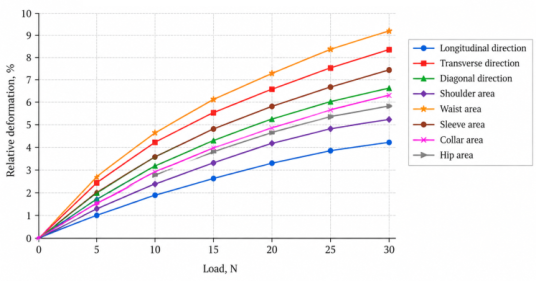
Figure 1. Comparative analysis of the relative deformation behavior of karakul fur under different loading conditions and in different garment zones.
Figure 1 presents the changes in relative deformation of karakul fur depending on the applied load and the location or orientation of the material. The results demonstrate a clear increasing trend in deformation as the mechanical load increases from 5 to 30 N. However, the intensity of deformation differs considerably between the investigated directions and garment zones, confirming the anisotropic and heterogeneous mechanical behavior of karakul fur.
The waist area demonstrates the highest deformation throughout the investigated loading range. At a load of 30 N, its relative deformation reaches approximately 9.2%. The transverse direction also exhibits a relatively high deformation level, reaching approximately 8.4% at the same load. These results indicate that areas exposed to greater stretching and movement require increased consideration during pattern development.
The sleeve area demonstrates a deformation of approximately 7.4%, while the diagonal direction reaches about 6.6% at 30 N. These intermediate values indicate that both material orientation and functional loading influence the dimensional behavior of fur components. The collar area shows approximately 6.3% deformation, suggesting that even relatively small construction components can undergo noticeable dimensional changes.
The lowest deformation is observed in the longitudinal direction, where the value reaches approximately 4.2% at 30 N. The shoulder and hip areas demonstrate intermediate-low deformation levels. This difference between the longitudinal and transverse directions confirms that the mechanical response of karakul fur is direction-dependent.
From a design perspective, the obtained relationship demonstrates the necessity of introducing differentiated deformation allowances rather than applying identical corrections to all outerwear components. Components located in zones with higher deformation should be designed with appropriate dimensional compensation, while components oriented along directions with lower deformation may require smaller corrections.
Thus,
Figure 1 provides visual confirmation of the main methodological principle of the study: the deformation characteristics of karakul fur should be considered as an integral design parameter when determining the dimensions, orientation, and constructional configuration of outerwear components. This approach can improve dimensional stability, reduce shape distortion, and contribute to higher technological and aesthetic quality of finished fur garments.
5. Conclusion
This study has demonstrated the importance of considering the deformational properties of karakul fur when developing outerwear components. The analysis confirms that the mechanical response of karakul fur is characterized by considerable variability depending on the direction of loading and the functional location of the material within the garment. Therefore, the application of uniform construction allowances to all garment components cannot fully ensure the required dimensional accuracy and shape stability of fur outerwear.
The obtained results indicate that relative deformation increases with increasing mechanical load, while its magnitude differs between the longitudinal, transverse, and diagonal directions as well as between individual garment zones. The highest deformation was observed in the waist area and in the transverse direction, whereas the longitudinal direction demonstrated comparatively lower deformation. These differences provide evidence that both material orientation and functional loading should be incorporated into the pattern-development process.
The proposed design methodology establishes a relationship between experimentally determined deformation characteristics and geometric parameters of outerwear components. The introduction of differentiated deformation allowances makes it possible to compensate for expected dimensional changes and improve the correspondence between the designed pattern and the actual behavior of karakul fur during technological processing and wear. Particular attention should be given to components subjected to repeated mechanical stresses, including waist and sleeve areas.
The research also demonstrates that deformation-sensitive pattern construction can contribute to improved dimensional stability, more accurate joining of individual components, preservation of the intended garment silhouette, and reduction of constructional deviations. In addition, consideration of the mechanical characteristics of individual fur pieces can support more rational material utilization and reduce unnecessary corrections during manufacturing.
From a scientific and practical perspective, the results provide a basis for integrating material-specific mechanical parameters into fur garment design technologies. The proposed approach can be further developed through expanded experimental studies involving different grades, thicknesses, moisture conditions, and structural characteristics of karakul skins. Future investigations should also focus on repeated loading, long-term deformation, temperature and humidity effects, and statistical validation of deformation coefficients.
In conclusion, incorporating the deformational behavior of karakul fur into the design of outerwear components represents an effective direction for improving the reliability and technological efficiency of fur garment construction. The transition from generalized construction parameters toward experimentally substantiated, material-specific design corrections can enhance the functional, dimensional, and aesthetic performance of finished karakul outerwear.
Abbreviations
Dt | Target Component Dimension |
ISO | International Organization for Standardization |
ASTM | ASTM International (Formerly American Society for Testing and Materials) |
ε | Relative Deformation / Strain, Expressed as a Percentage |
L0 | Initial Specimen Gauge Length |
L1 | Specimen Length Under the Specified Load |
Author Contributions
Khonkeldiyeva Nigora Akramovna: Data curation, Formal Analysis, Funding acquisition, Methodology, Resources, Software, Validation, Writing – original draft, Writing – review & editing
Kamilova Khalida Khafizovna: Conceptualization, Data curation, Formal Analysis, Funding acquisition, Investigation, Methodology, Resources, Validation, Writing – original draft, Writing – review & editing
Conflicts of Interest
The authors declare no conflicts of interest.
References
| [1] |
Nemirova, L. F., Litunov, S. N., Tashpulatov, S. S., Sabirova, Z. A., & Zhilisbayeva, R. O. (2019). Research of properties of fur karakul, seal, mink under uniaxial tension. Tekhnologiya Tekstil'noy Promyshlennosti, 6(384), 111–116.
|
| [2] |
Tashpulatov, S. S., Sabirova, Z. A., Nemirova, L. F., & Shin, I. G. (2020). Research of deformation properties of natural fur for producing full-formed products. Tekhnologiya Tekstil'noy Promyshlennosti.
|
| [3] |
Kamilova, K. K., Khankeldiyeva, N. A., & Usmanov, K. S. (2026). Analysis of formation methods taking into account the features of karakul features. Universum: Technical Sciences, 5(146).
|
| [4] |
Näsholm, A., & Eythorsdottir, E. (2011). Characteristics and utilization of sheep pelts. Small Ruminant Research, 101(1–3), 182–187.
https://doi.org/10.1016/j.smallrumres.2011.09.038
|
| [5] |
Efendioglu, N. O. (2026). Multi-angle assessment of leather strength and elasticity: Beyond standard parallel and perpendicular measurement. Journal of Industrial Textiles.
https://doi.org/10.1177/15280837251374750
|
| [6] |
Basaran, B., & Nalbat, S. (2012). A study of the realistic strength of leather: True stress. Journal of the American Leather Chemists Association.
|
| [7] |
Cooklin, G., Hayes, S. G., & McLoughlin, J. (2006). Introduction to clothing manufacture (2nd ed.). Blackwell Science.
|
| [8] |
International Organization for Standardization. (2020). ISO 3376: 2020: Leather—Physical and mechanical tests—Determination of tensile strength and percentage elongation. ISO.
|
| [9] |
International Organization for Standardization. (2023). ISO 2418: 2023: Leather—Chemical, physical, mechanical and fastness tests—Position and preparation of specimens for testing. ISO.
|
| [10] |
ASTM International. (2025). ASTM D2209-25: Standard test method for tensile strength and elongation of leather. ASTM International.
https://doi.org/10.1520/D2209-25
|
Cite This Article
-
APA Style
Akramovna, K. N., Khafizovna, K. K. (2026). Improvement of Methods for Designing Outerwear Components Taking into Account the Deformational Properties of Karakul Fur. American Journal of Materials Synthesis and Processing, 11(2), 52-59. https://doi.org/10.11648/j.ajmsp.20261102.12
 Copy
|
 Download
ACS Style
Akramovna, K. N.; Khafizovna, K. K. Improvement of Methods for Designing Outerwear Components Taking into Account the Deformational Properties of Karakul Fur. Am. J. Mater. Synth. Process. 2026, 11(2), 52-59. doi: 10.11648/j.ajmsp.20261102.12
Copy
|
Download
AMA Style
Akramovna KN, Khafizovna KK. Improvement of Methods for Designing Outerwear Components Taking into Account the Deformational Properties of Karakul Fur. Am J Mater Synth Process. 2026;11(2):52-59. doi: 10.11648/j.ajmsp.20261102.12
Copy
|
Download
-
@article{10.11648/j.ajmsp.20261102.12,
  author = {Khonkeldiyeva Nigora Akramovna and Kamilova Khalida Khafizovna},
  title = {Improvement of Methods for Designing Outerwear Components Taking into Account the Deformational Properties of Karakul Fur},
  journal = {American Journal of Materials Synthesis and Processing},
  volume = {11},
  number = {2},
  pages = {52-59},
  doi = {10.11648/j.ajmsp.20261102.12},
  url = {https://doi.org/10.11648/j.ajmsp.20261102.12},
  eprint = {https://article.sciencepublishinggroup.com/pdf/10.11648.j.ajmsp.20261102.12},
  abstract = {This study presents a methodological framework for incorporating the direction-dependent deformation characteristics of karakul fur into the design of outerwear components. The primary objective is to demonstrate how relative deformation indicators can be interpreted and translated into practical considerations for garment pattern development. The study is structured as a methodological demonstration based on illustrative values rather than an experimental investigation of physical specimens. A relative-deformation measure is introduced to describe dimensional changes in different material directions. A conceptual procedure is then proposed for comparing deformation indicators across material orientations and garment zones and for determining differentiated pattern allowances according to the expected deformation behavior of the material. The illustrative values serve exclusively to explain the calculation procedure and demonstrate the potential application of the proposed framework. They do not represent experimentally measured properties, validated deformation coefficients, or statistically established characteristics of karakul fur. The proposed methodology provides a structured approach for organizing deformation-related information and identifying potential adjustments to pattern dimensions during the preliminary design of outerwear. However, its practical reliability remains limited by the absence of an experimentally validated dataset and quantitative relationships between material deformation and garment dimensional stability. Future research should investigate karakul fur specimens with documented origins, grades, and processing conditions. Experimental procedures should follow applicable conditioning requirements and standardized testing methods to ensure the reproducibility and comparability of measurements. Particular attention should be given to evaluating deformation under different loading conditions, material directions, and environmental influences. Subsequently, the relationship between measured deformation indicators and dimensional changes in finished garment components should be statistically analyzed and experimentally validated. These investigations would establish an evidence-based foundation for developing reliable deformation coefficients and improving the accuracy of pattern corrections for karakul fur outerwear.},
 year = {2026}
}
Copy
|
Download
-
TY  - JOUR
T1  - Improvement of Methods for Designing Outerwear Components Taking into Account the Deformational Properties of Karakul Fur
AU  - Khonkeldiyeva Nigora Akramovna
AU  - Kamilova Khalida Khafizovna
Y1  - 2026/10/31
PY  - 2026
N1  - https://doi.org/10.11648/j.ajmsp.20261102.12
DO  - 10.11648/j.ajmsp.20261102.12
T2  - American Journal of Materials Synthesis and Processing
JF  - American Journal of Materials Synthesis and Processing
JO  - American Journal of Materials Synthesis and Processing
SP  - 52
EP  - 59
PB  - Science Publishing Group
SN  - 2575-1530
UR  - https://doi.org/10.11648/j.ajmsp.20261102.12
AB  - This study presents a methodological framework for incorporating the direction-dependent deformation characteristics of karakul fur into the design of outerwear components. The primary objective is to demonstrate how relative deformation indicators can be interpreted and translated into practical considerations for garment pattern development. The study is structured as a methodological demonstration based on illustrative values rather than an experimental investigation of physical specimens. A relative-deformation measure is introduced to describe dimensional changes in different material directions. A conceptual procedure is then proposed for comparing deformation indicators across material orientations and garment zones and for determining differentiated pattern allowances according to the expected deformation behavior of the material. The illustrative values serve exclusively to explain the calculation procedure and demonstrate the potential application of the proposed framework. They do not represent experimentally measured properties, validated deformation coefficients, or statistically established characteristics of karakul fur. The proposed methodology provides a structured approach for organizing deformation-related information and identifying potential adjustments to pattern dimensions during the preliminary design of outerwear. However, its practical reliability remains limited by the absence of an experimentally validated dataset and quantitative relationships between material deformation and garment dimensional stability. Future research should investigate karakul fur specimens with documented origins, grades, and processing conditions. Experimental procedures should follow applicable conditioning requirements and standardized testing methods to ensure the reproducibility and comparability of measurements. Particular attention should be given to evaluating deformation under different loading conditions, material directions, and environmental influences. Subsequently, the relationship between measured deformation indicators and dimensional changes in finished garment components should be statistically analyzed and experimentally validated. These investigations would establish an evidence-based foundation for developing reliable deformation coefficients and improving the accuracy of pattern corrections for karakul fur outerwear.
VL  - 11
IS  - 2
ER  -
Copy
|
Download







 Share This Article
 Twitter
 Linked In
 Facebook